
How to Buy Shoes in Bulk: A Practical Wholesale Buyer’s Guide
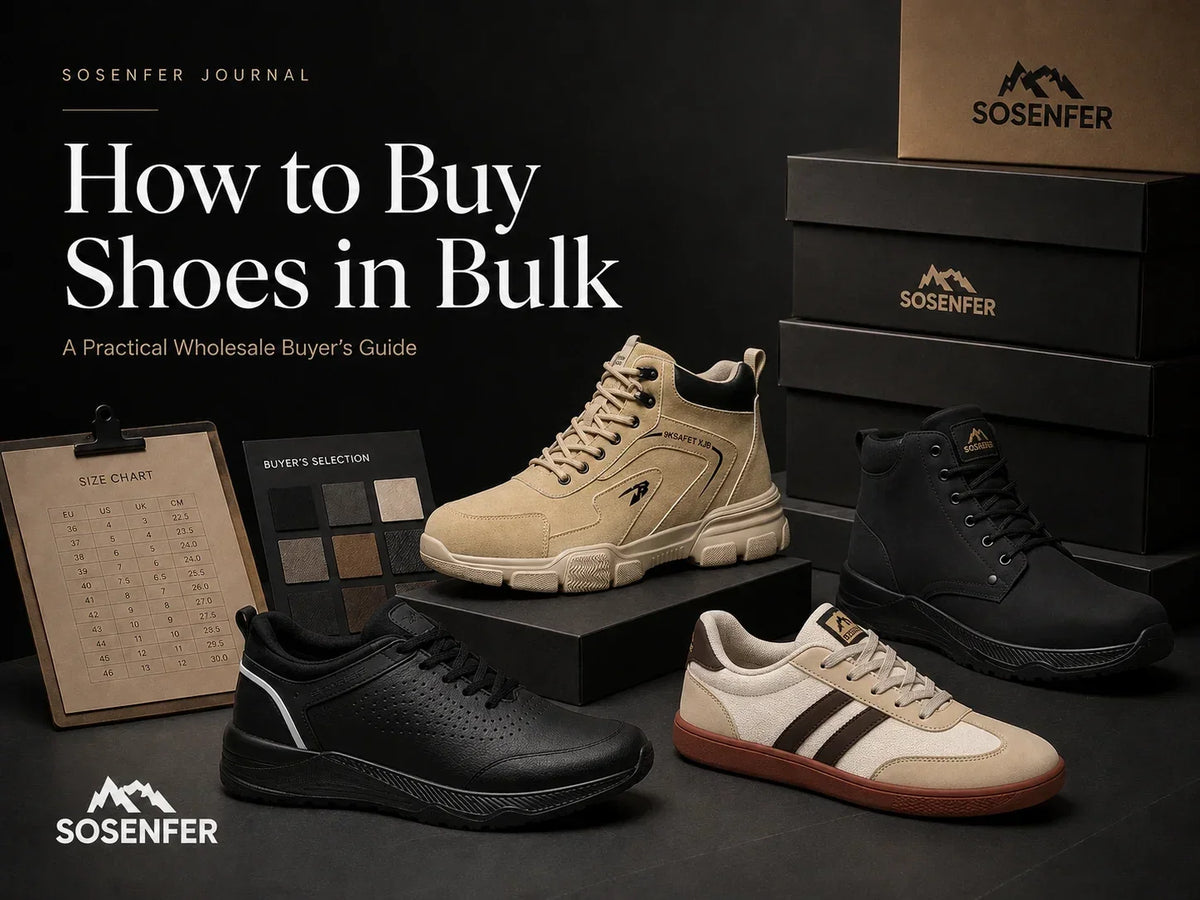
Buying shoes in bulk becomes much easier when you are not forced to piece together products, fit decisions, sampling, branding, and development from several different suppliers.
At Sosenfer, wholesale projects can begin with existing footwear, move into private-label adaptations, or develop into a more original shoe program when the project calls for it. Our current wholesale range covers safety and work shoes, wide-fit footwear, slip-on and hands-free styles, barefoot-style shoes, men’s and women’s ranges, and selected custom development projects.
If you are looking for a bulk shoe supplier, the most useful starting point is not simply “What is your lowest price?” It is finding the Sosenfer route that already comes closest to the product you want to sell, supply, or build.
SOSENFER WHOLESALE
Some buyers already know exactly what they need. Others arrive with a customer profile, a use environment, or a product reference and want to see which route makes the most commercial sense.
Sosenfer is structured around both situations. Instead of treating every inquiry as the same generic “shoe order,” we can organize the project around the footwear category, fit direction, level of customization, market, and intended use.
Category Range
Safety, wide-fit, slip-on, barefoot-style, casual, men’s, and women’s footwear can all sit within the same wholesale relationship.
Fit Direction
Wide forefeet, toe geometry, internal volume, instep, heel hold, entry opening, and size grading can all matter depending on the customer.
Development
When an existing style is not enough, Sosenfer also has routes for outsole, upper, and shoe-last development.
A SIMPLE START
A product link, category, target customer, expected quantity, destination, and the main changes you are considering are enough to begin a useful conversation. From there, the project can be organized around what is already available and what may need development.
Start with the Sosenfer wholesale overviewThe fastest way to understand what Sosenfer can offer is to start with the customer problem you are trying to solve.
Work & Protection
For work footwear programs where protective structures, fit, outsole needs, testing, documentation, and workplace use all matter.
Explore wholesale safety shoesWide Fit
For buyers focused on wider forefoot shapes, wide toe box constructions, selected extra-wide directions, or customers who simply need more usable room.
Explore wide-fit shoes in bulkEasy Entry
For walking, everyday, retail, and selected work-focused programs where easy entry is part of the product value.
Explore wholesale slip-on shoesNatural Movement
For flexible, low-bulk, foot-shaped and minimalist directions across men’s, women’s, and unisex ranges.
Explore barefoot shoes in bulkBrand Programs
For sneakers, walking styles, flats, slip-ons and casual collections where branding or selected product adaptation is part of the plan.
Explore private-label shoe programsMen’s Range
For men’s safety, wide-fit, walking, hands-free, barefoot-style, work, and casual footwear assortments.
Explore bulk men’s shoesWomen’s Range
For women’s safety, wide-fit, easy-entry, walking, barefoot-style, lightweight, and refined casual footwear programs.
Explore wholesale women’s shoesSOSENFER BUSINESS
If you are building a mixed assortment, you can share all the categories you are considering in one inquiry. We can separate the request into existing styles, adaptations, development needs, sampling, and commercial planning.
This is especially useful for distributors, retailers, employers, and brands that do not want to start a separate supplier search for every footwear direction.
Start a Wholesale Shoe InquiryNot every wholesale project needs to begin from zero. In many cases, a current Sosenfer style already provides the fit, function, or category direction the buyer needs.
| Project Direction | Works Well When | What Sosenfer Can Review |
|---|---|---|
| Existing wholesale style | The current product already fits the market and customer direction | Availability, sizes, colors, quantity, packaging and delivery |
| Existing style with adaptations | The core shoe works but the commercial presentation needs to feel more like your brand | Branding, colors, selected materials, packaging, feasibility and revised samples |
| New development | The intended fit, function, construction or visual identity does not already exist | Outsole, upper, last, tooling, grading, testing and development stages |
For many buyers, starting from an existing product is the easier way to test a market. If the product proves itself, the program can then become more specific over time.
You do not need to turn your first message into a technical specification. A few commercial details simply help us understand which Sosenfer route is most relevant.
Retail customers, employees, teams, men, women, or a specific customer profile.
Safety, wide-fit, slip-on, barefoot-style, walking, casual, or another clear direction.
An estimated quantity by style is enough for the first review.
Share the size range and any known fit direction, such as wide forefoot or higher internal volume.
The destination market and use environment help shape product and documentation discussions.
Logo, packaging, colors, materials, fit, outsole, upper, last, or a completely new product direction.
If some of these details are still undecided, that is fine. The purpose of the first conversation is to narrow the project—not to expect the buyer to arrive with every production decision already made.
Terms such as wide, extra wide, 4E, wide toe box, and foot-shaped are often used as if they describe the same fit. In practice, they can refer to very different constructions.
For a wholesale program, that difference matters because the customer feels the fit—not the label on the product page.
Depending on the style, a Sosenfer fit discussion can include toe geometry, forefoot width, total internal volume, instep, heel hold, entry opening, base size, and grading. This is particularly relevant for wide-fit, safety, barefoot-style, and easy-entry footwear.
FIT LAB
Sosenfer’s custom shoe-last development route can review toe shape, forefoot width, internal volume, instep, heel hold, silhouette, base size, and grading around the intended wearer.
Explore custom shoe last developmentSafety and occupational shoes need a little more context than ordinary casual footwear because the product, destination, use environment, test standard, protective construction, and supporting documentation can all affect the final route.
If your program includes safety, slip-resistant, waterproof, ESD, puncture-resistant, or other performance-led footwear, share the destination and intended use with us early. That gives the project a more reliable starting point.
For safety programs: certification and supporting documents are reviewed against the exact product, final specification, target standard, and destination rather than assumed to apply universally across every variation.
Photos are useful for narrowing the direction. Samples are where fit, construction, flexibility, weight, entry, materials, branding, and workmanship become much easier to evaluate.
The sample route depends on the project. An existing wholesale style may need a straightforward product sample. A private-label project may involve color, material, branding, or packaging confirmation. A new development can require several review stages before production.
We can organize the sample discussion around the amount of change you actually need rather than treating every order as a full development project.
Two shoe quotations can look very different even when the headline unit price seems similar.
The commercial scope may include only the footwear, or it may also involve samples, revisions, branding, packaging, tooling, testing, documentation, inspection, freight, or other project-specific items.
That is why Sosenfer’s wholesale conversation starts with the product route and project scope. Once those are clearer, pricing becomes more useful because you know what the quotation is actually built around.
A good first order is important. A workable second order is what turns the product into a real program.
For retailers and distributors, this can include size mix, color mix, replenishment timing, material continuity, and future production planning. For employers and team buyers, it can mean keeping a practical spread of sizes available as new wearers join the program.
If you already expect repeat orders, mention that in the first inquiry. It gives the project a different commercial context than a one-time purchase.
Some projects are better served by an existing product. Others eventually need something more specific.
When the product needs to move beyond branding and color changes, Sosenfer can separate development into the parts of the shoe that actually need to change.
OUTSOLE LAB
For tread architecture, flex grooves, contact patterns, cushioning geometry, material direction, weight, color, texture, and original brand expression.
Explore custom shoe outsolesUPPER LAB
For mesh, knit, textile, reinforcement, lining, water management, support, closure, slip-on, and easy-entry structures.
Explore functional shoe upper developmentFIT LAB
For toe geometry, forefoot width, internal volume, instep, heel hold, silhouette, base size, and grading.
Explore custom shoe last developmentHAVE A PRODUCT DIRECTION IN MIND?
Send us the style or category you are interested in, your estimated quantity, size range, destination, and any branding or product changes you are considering. We can take it from there.
Start Your Sosenfer Wholesale InquiryYes. Sosenfer reviews bulk inquiries across safety, wide-fit, slip-on, barefoot-style, casual, men’s, and women’s footwear, together with selected private-label and custom development projects.
No. A category, customer profile, product reference, expected quantity, destination, and the main features you are looking for can be enough to begin narrowing the right route.
Yes. Existing wholesale styles are often the most direct option when the current product already fits the intended customer and market.
Yes. Depending on the product and commercial feasibility, projects may review branding, colors, packaging, selected materials, and other practical adaptations.
Selected projects can review new outsole, upper, last, fit, construction, tooling, grading, testing, or complete footwear development depending on the product direction.
Minimum quantities vary by product, quantity by style and color, inventory, materials, customization, tooling, testing, packaging, and production route. Share the product and estimated quantity you are considering and the applicable route can be reviewed.
A size mix can be included in the inquiry. The available distribution depends on the selected product, quantity, inventory or production plan, and packing requirements.
Yes. If you are considering safety, wide-fit, slip-on, barefoot-style, casual, men’s, or women’s footwear at the same time, include the categories in one inquiry and the project can be separated into the relevant routes.
Yes. For safety projects, the intended workplace, destination, protective direction, outsole needs, size range, quantity, documentation, packaging, and timing can be reviewed against the selected product.
Timing depends on whether the project uses an existing style or requires adaptations or new development, together with samples, materials, testing, production, packaging, transportation, and destination processing.
For some buyers, the right answer is already in the Sosenfer wholesale range. For others, an existing style becomes the starting point for a more specific private-label program. And for projects with a clear commercial reason to go further, custom outsole, upper, and last development can open a more original route.
The important part is that you do not have to decide all of that before contacting us.
Show us the customer, category, product direction, quantity, and market you have in mind. We can help connect that idea to the most suitable Sosenfer wholesale path.
SOSENFER WHOLESALE
Explore our wholesale categories or send us the product direction you are considering. Existing styles, private-label adaptations, and selected custom development can all begin from the same conversation.
Explore Sosenfer WholesaleCommercial-information note: Product availability, minimum quantities, pricing, samples, customization, tooling, testing, documentation, packaging, transportation, and delivery timing depend on the selected product and confirmed project requirements.


