
Why Does Standing Still Hurt More Than Walking in Work Shoes?
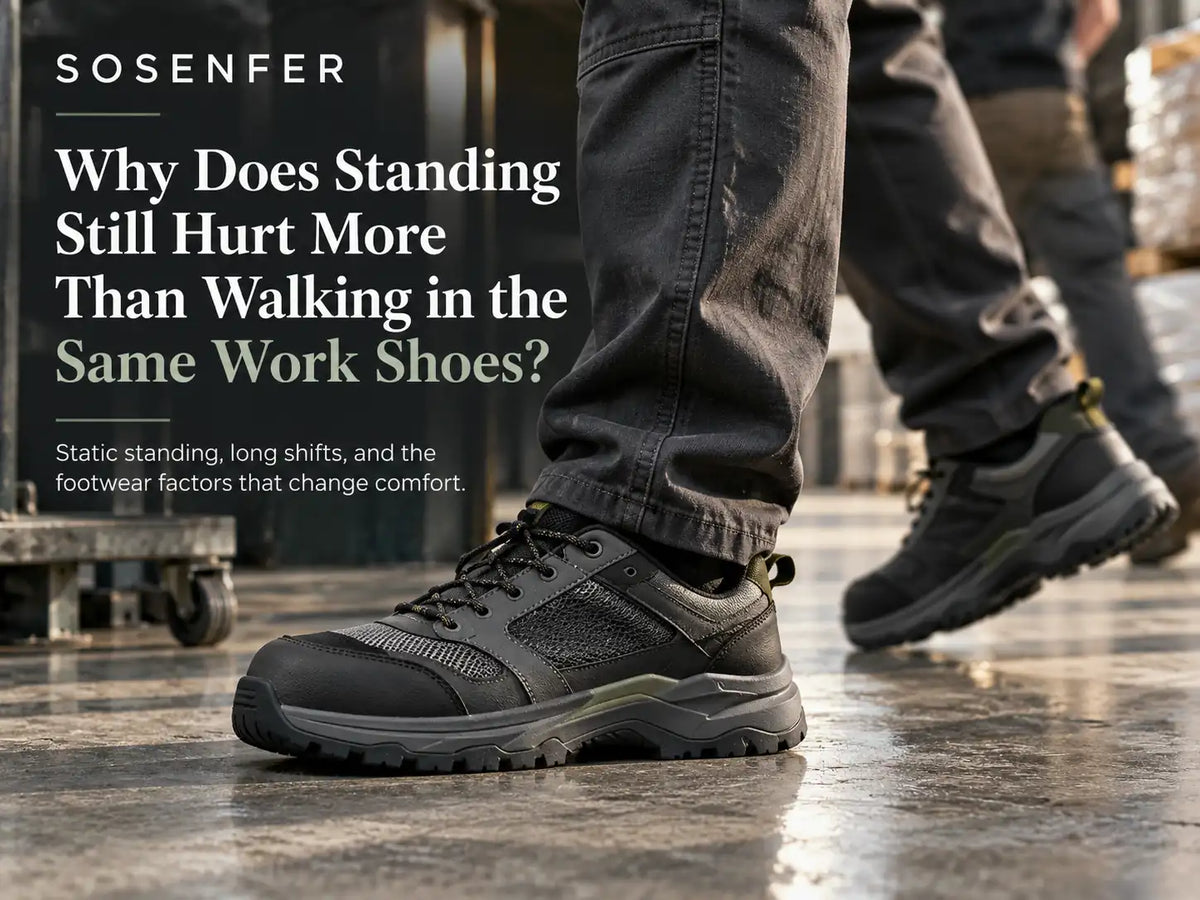
You can walk across a warehouse for twenty minutes and barely think about your work shoes.
Then you stop at a workstation.
Ten minutes later, your heels feel heavier.
The balls of your feet begin to feel pressure.
Your legs feel more tired—even though you are doing less.
That sounds backwards.
So why can standing still hurt more than walking in the exact same pair of work shoes?
Standing still can feel harder than walking because your feet and lower limbs remain under relatively continuous load while your body makes fewer large movement changes.
When you walk, pressure shifts from heel to forefoot and from one foot to the other. Your ankle and calf muscles repeatedly move, and different tissues share the load through each step.
During prolonged static standing, pressure can remain concentrated in similar areas for longer periods. Hard flooring, limited cushioning, narrow toe space, poor heel support, shoe wear, and a workstation that keeps you almost completely motionless can make the difference more noticeable.
Walking looks like more work.
Mechanically, it is.
But walking also changes where and how your body is loaded.
During each step:
Standing still removes much of that variation.
Your feet remain on the same surface, in nearly the same position, carrying body weight through similar areas again and again.
A shoe that feels excellent while moving is not automatically optimized for standing at a counter for several hours.
Walking emphasizes:
Static standing emphasizes:
Pressure travels through the foot and alternates between sides as each step progresses.
Similar areas can remain loaded for longer periods, making local pressure and fatigue easier to notice.
Small movements change the mechanical demand on your feet and legs.
When you walk:
This is why workers sometimes notice that a short walk to another workstation feels like relief after standing in one place.
The shoe did not suddenly become softer.
The loading pattern changed.
The exact location differs from person to person.
Common areas include:
The location matters because different discomfort patterns suggest different things to check.
| Where You Notice Discomfort | What May Be Contributing | What to Check |
|---|---|---|
| Heel | Sustained heel loading, compressed cushioning, fit | Heel cushioning, shoe age, insole condition |
| Ball of foot | Forefoot pressure or load concentration | Forefoot cushioning, shoe shape, floor hardness |
| Sides of toes | Narrow or tapered toe box | Usable forefoot width |
| Top of toes | Limited toe-box depth | Vertical clearance |
| Whole foot feels tired | Static load, hard floor, worn cushioning, shoe weight | Overall shoe condition and task pattern |
| Lower legs | Prolonged static posture may contribute | Movement opportunities and workstation setup |
During stationary standing, the heel can remain under continuous load for a relatively long period.
Walking repeatedly changes that load.
The heel contacts the ground, bears weight, then unloads as the body moves forward.
If your shoes feel noticeably worse under the heel during standing, check:
We cover heel-specific footwear factors separately in our guide to heel discomfort during long workdays .
Concrete, tile, industrial flooring, and other firm surfaces provide very little deformation beneath the shoe.
Your footwear therefore becomes a major part of the interface between your foot and the floor.
When walking, cushioning also manages repeated impact.
When standing, another question becomes important:
how does the shoe feel after the cushioning has remained compressed beneath your body weight for a long period?
A shoe that feels soft for five steps may not feel the same after forty minutes at a workstation.
“Soft” and “comfortable for static standing” are not automatically the same thing.
Extremely soft cushioning can feel pleasant initially, while too little structure may feel less stable over time. A very hard sole can provide stability but create more noticeable localized pressure. The goal is a usable balance for your task.
If your job is specifically dominated by concrete-floor standing, also read Are Barefoot Shoes Good for Standing on Concrete All Day? .
No.
Cushioning can help reduce the harsh feel of a firm floor, but more softness is not automatically better.
A work shoe also needs to feel stable.
If cushioning is extremely soft, your foot may continually make small corrections to remain balanced.
If the sole is very hard, pressure can feel more concentrated.
This is why useful standing footwear often combines:
Shoes change with use.
Foam compresses.
Insoles flatten.
Outsoles wear.
Heel structure can soften.
The upper conforms to the foot.
Some of those changes are normal.
But if a shoe that once handled standing comfortably now feels noticeably harsher, inspect the underfoot structure rather than assuming your feet simply need to “get used to it.”
Because standing is still weight-bearing.
Your forefoot is not floating inside the shoe.
If the toe box tapers sharply, continuous standing can make that shape more noticeable as the shift continues.
You may feel:
A wider toe box is not a treatment for all standing discomfort.
But if your current shoes are visibly compressing the forefoot, giving the toes more usable space is a logical fit issue to address.
For the broader fit discussion, read Best Wide Toe Box Work Shoes for Long Shifts .
Shoe weight becomes especially noticeable when you repeatedly lift the foot.
That makes lightweight construction valuable for workers who walk long distances, climb stairs, or constantly move between stations.
But when you are standing still, you are not repeatedly lifting the shoe.
Other factors move higher on the priority list:
A very light shoe can therefore be excellent for walking without automatically being your best standing shoe.
Several effects can accumulate during the day.
Your shoes have been loaded for hours.
Your feet may feel fuller.
Cushioning has been repeatedly compressed.
Your posture may become less varied as fatigue increases.
A fit that felt acceptable at 8:00 a.m. can therefore feel more restrictive at 4:00 p.m.
This is why work shoes should be evaluated for the whole shift, not only the first five minutes after you put them on.
Start by changing one variable at a time.
Notice whether discomfort decreases after a few minutes of movement or continues unchanged.
If one pair is consistently worse during standing than another on the same floor, footwear construction is likely contributing.
Look for permanent flattening, uneven compression, torn foam, or a surface that no longer recovers.
Stand normally and see whether your toes are pressed together or pushed against the sides of the shoe.
Your heel should feel supported without being painfully squeezed.
If a short period of walking, shifting position, or alternating tasks consistently reduces discomfort, uninterrupted static standing itself may be contributing.
This is an important shopping mistake to avoid.
The common reaction is:
“My feet hurt standing, so I need the softest shoe possible.”
But standing comfort is a system.
It includes:
Fixing only one characteristic may not solve the actual problem.
Small changes are better than maintaining exactly the same stance for long periods.
A short trip to another workstation can change the loading pattern through the feet and lower legs.
Static standing, walking, sitting, and other movements place different demands on the body.
Standing on hard industrial flooring all day is different from standing on a more forgiving surface.
An upper can look almost new while the cushioning inside has already lost a noticeable amount of resilience.
Thick socks change internal volume, while moisture and friction can change how the foot feels later in the shift.
Footwear cannot diagnose or treat an underlying medical condition.
Persistent, severe, worsening, or unexplained pain deserves appropriate professional assessment.
Hard floors often make underfoot cushioning more noticeable.
The shoe should not feel as though your foot is continually sinking or rolling around while stationary.
The toes should not spend an eight-hour shift pushed tightly together.
More forefoot room should not require a loose, uncontrolled heel.
If your job mixes standing and walking, excess shoe mass still matters when you begin moving again.
A removable insole can make it easier to inspect wear and compare the underfoot setup over time.
Comfort is only one part of work footwear.
Depending on the job, you may also need to verify:
Work footwear should not be selected from one five-minute try-on. Compare how the shoe handles stationary pressure, forefoot room, cushioning, heel stability, repeated walking, and the actual floor you work on.
GlideFree combines an anatomical wide toe box with cushioned anti-fatigue foam, a supportive flat heel structure, and a slip-resistant rubber outsole. It is designed for work shifts, warehouse environments, service settings, healthcare-style routines, commuting, and all-day standing.
View GlideFreeFlexGuard is a stronger direction when your job also requires protective footwear. Its roomier forefoot and lighter work-shoe construction are designed around long shifts without forcing the toes into a sharply tapered front.
View FlexGuardProtective footwear adds another layer to the decision.
Safety shoes can contain:
Those features can change weight, flexibility, and available internal space.
If you need protection and also dislike narrow safety footwear, compare the Sosenfer Wide Toe Box Safety Shoes collection and verify the individual protection specification before ordering.
This does not mean you need two different pairs for every job.
It means different tasks reveal different properties.
Walking makes you notice:
Standing makes you notice:
If your job involves both, buy for the combination rather than optimizing exclusively for one.
Standing still can feel harder because your feet remain under continuous, relatively unchanging load.
When you walk, pressure moves through the foot, your weight alternates between sides, your ankles move, and different tissues repeatedly load and unload.
During prolonged static standing, similar areas beneath the heel and forefoot may remain loaded for much longer. Hard flooring, compressed cushioning, narrow toe boxes, poor heel stability, and worn footwear can make that effect more noticeable.
If the same work shoes feel fine while walking but uncomfortable while stationary, do not judge them only by softness. Check cushioning, stability, toe space, heel fit, shoe condition, floor surface, and how long your job keeps you in one position.
Static standing keeps similar areas of the feet loaded for longer periods. Walking repeatedly shifts pressure, alternates weight between the feet, and changes ankle and lower-leg movement.
Walking and standing emphasize different footwear characteristics. Walking makes flexibility, weight, and transition more noticeable, while prolonged standing emphasizes sustained cushioning, stability, toe space, and underfoot pressure.
It can feel that way during prolonged periods. Static standing produces sustained loading with less variation, while walking continually changes how pressure is distributed. Individual response, floor surface, footwear, and health factors also matter.
The heel may remain under relatively continuous load while you stand. Check cushioning condition, insole wear, shoe fit, floor hardness, and whether the discomfort also occurs in other footwear.
No. Cushioning can reduce the harsh feel of hard flooring, but standing comfort also depends on stability, shoe shape, fit, toe room, and the specific task. Extremely soft is not automatically better.
A wider toe box can be useful if narrow footwear compresses your toes or forefoot during long shifts. Overall standing comfort also depends on cushioning, heel fit, stability, floor surface, and the individual shoe.
Movement changes the loading pattern through the feet and legs. Pressure shifts through each step, one foot periodically unloads, and ankle and calf movement increases compared with a nearly stationary posture.
A cushioned footbed may feel more comfortable on hard surfaces, but foam type alone does not determine standing comfort. Stability, thickness, compression over time, shoe shape, and fit all matter.
Look for permanently flattened insoles, compressed midsoles, uneven outsole wear, reduced heel stability, new pressure points, or a clear decline in comfort compared with when the shoes were newer.
For non-safety work environments, the GlideFree Wide Work Sneaker combines an anatomical wide toe box, cushioned anti-fatigue foam, and a slip-resistant work outsole. If your workplace requires protective footwear, compare the FlexGuard Black Wide Pro Safety Shoes and other models in the Wide Toe Box Safety Shoes collection , then confirm the protection features required for your job.
Health and safety note: This article provides general footwear and occupational-comfort information. Shoes cannot diagnose or treat a medical condition. Persistent, severe, worsening, one-sided, or unexplained foot or leg pain, significant swelling, numbness, weakness, redness, or difficulty bearing weight should be assessed by an appropriate healthcare professional. Workplace footwear requirements vary; verify the individual model and employer requirements before selecting protective footwear.


