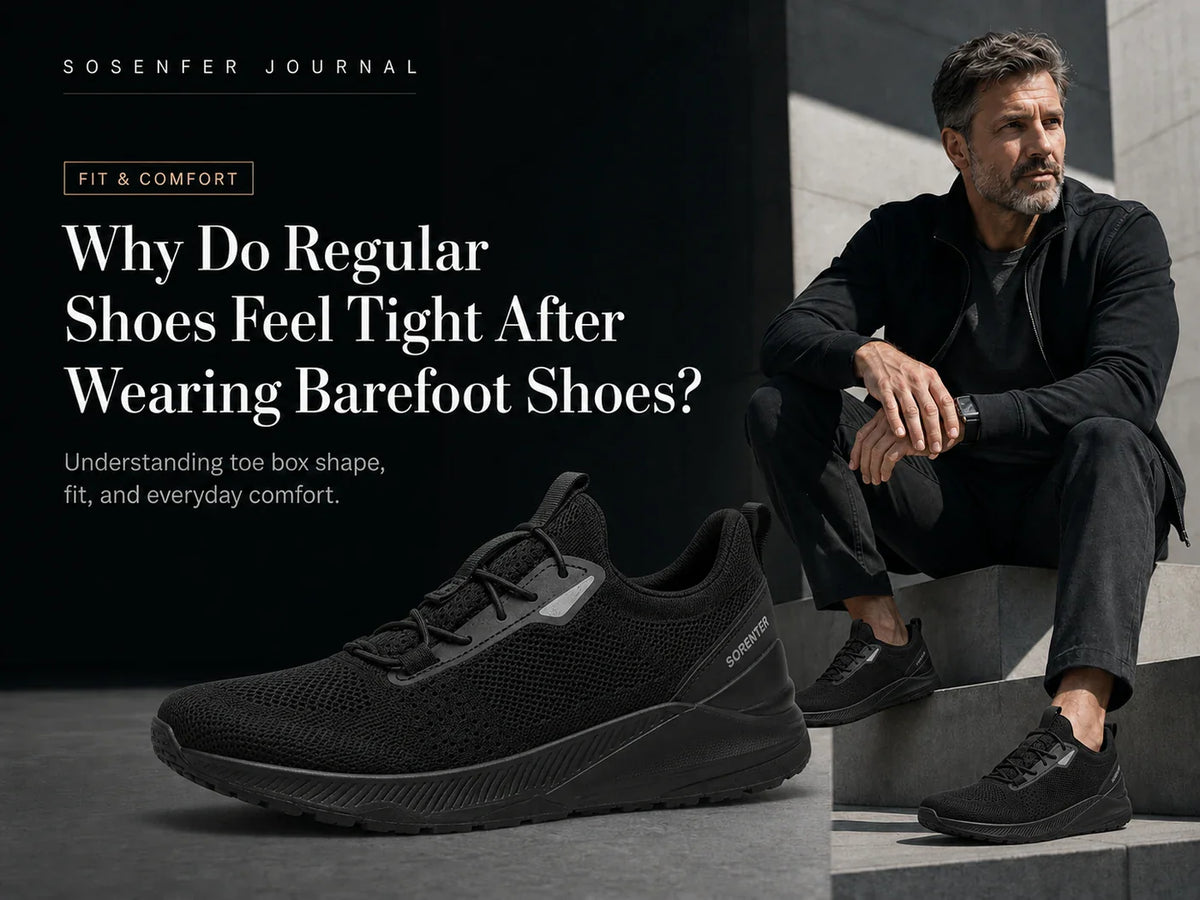
Why Do Regular Shoes Feel Tight After Wearing Barefoot Shoes?
, により Sosenfer , 22 分で読めます

, により Sosenfer , 22 分で読めます
You wear barefoot shoes for a few weeks or months, then put on an old pair of conventional sneakers.
The size has not changed. The shoes have not visibly shrunk. Yet the front suddenly feels narrow, the upper feels restrictive, and the sole seems heavier or stiffer than you remember.
This experience is common enough to raise an important question:
Why do regular shoes feel tight after wearing barefoot shoes?
The answer is usually not that barefoot shoes instantly changed the size of your feet. More often, you have become accustomed to a roomier toe shape, greater flexibility, lower heel elevation, and less structure around the foot. Returning to a narrower or stiffer shoe makes those differences much easier to notice.
Quick Answer
Barefoot-style shoes often provide a wider forefoot, flexible construction, lower heel-to-toe drop, and less rigid support. Once that freedom becomes familiar, a conventional shoe with a tapered toe box, firm upper, thick sole, or narrow last can feel more restrictive than it did before.
“Barefoot shoes” is a broad consumer term. Designs vary between brands, but many barefoot-style or minimalist shoes share several characteristics:
Conventional shoes may use a narrower last, thicker cushioning, a raised heel, a curved toe spring, firmer sidewalls, or a more structured upper. None of these features is automatically bad, but they create a different fit and walking experience.
The most common reason regular shoes feel tight after barefoot shoes is the difference in toe-box shape.
Many barefoot shoes have a broader front that follows the outline of the toes. Conventional shoes often narrow toward the front, especially around the big toe and little toe.
After becoming used to more forefoot space, you may notice that regular shoes:
The conventional shoes may have always fit this way. The difference is that the pressure now feels more obvious because your recent footwear did not create the same level of crowding.
Barefoot-Style Toe Box
Conventional Toe Box
Comfort is partly physical and partly perceptual. When you wear the same style of footwear every day, your brain may begin to treat that fit as normal.
After spending time in shoes with less pressure around the toes and sides, returning to a structured shoe creates a stronger contrast.
You may become more aware of:
This does not necessarily mean the regular shoe has suddenly become harmful. It means your reference point for comfort and freedom of movement may have changed.
Tightness is not always caused by width.
Barefoot-style shoes usually bend and twist more easily. When you return to a shoe with a thick or rigid platform, the foot may feel less able to flex through each step.
Because the sole controls more of the motion, the upper may also feel more noticeable around the foot. This can create an overall sensation of confinement even when the shoe is not dramatically narrower.
A conventional shoe may therefore feel tight, heavy, stiff, or disconnected rather than simply narrow.
Many barefoot shoes are zero-drop, meaning the heel and forefoot sit at approximately the same height. Conventional walking and running shoes often place the heel higher than the forefoot.
Returning to a higher-drop shoe may make your heel feel elevated and shift how your foot sits inside the upper. Depending on the shoe, you may notice more contact around the forefoot, a different pressure pattern, or a stronger feeling of being guided by the sole.
This does not mean zero-drop is always better. Different heel heights change the demands placed on the foot, ankle, calf, and Achilles tendon, and the most suitable design depends on the wearer, activity, experience, and existing symptoms.
Minimalist footwear changes how the foot interacts with the ground. Research has found that progressive walking in minimalist shoes can increase the size and strength of some intrinsic foot muscles.
Other studies have also found differences in lower-leg muscle activity when people walk barefoot, in minimalist footwear, or in conventional shoes.
These changes do not mean barefoot shoes transform every foot in the same way. However, once your feet become accustomed to participating differently during walking, a highly structured shoe may feel less natural or more restrictive.
Your toes may rest and move differently in a wider shoe, and your awareness of pressure may change. But it is too simplistic to assume that several weeks in barefoot shoes permanently widens every person’s foot. Fit changes depend on anatomy, age, activity, footwear history, time, and individual response.
Sometimes the explanation is straightforward: the regular shoes were never an ideal shape for your feet.
Before wearing barefoot shoes, you may have accepted toe pressure as normal. After experiencing a roomier shape, the poor fit becomes easier to recognize.
Signs that the conventional shoes may genuinely be too tight include:
A shoe should match the shape of your foot. Your foot should not have to tolerate repeated pressure while waiting for a narrow shoe to stretch.
| Feature | Common Barefoot-Style Design | Common Conventional Design |
|---|---|---|
| Toe box | Broad or foot-shaped | May taper toward the toes |
| Sole flexibility | Usually highly flexible | Often firmer or more structured |
| Cushioning | Usually thin and minimal | May use thicker foam or a higher platform |
| Heel-to-toe drop | Often zero or very low | Frequently higher |
| Ground feel | More noticeable | More isolated by cushioning |
| Structure | Less rigid support | May include stiff heel counters and support elements |
Do not rely only on the number printed inside the shoe. Check each part of the fit while standing and walking.
When regular shoes feel tight after barefoot shoes, the first instinct may be to buy a larger size.
That only helps when the shoe is genuinely too short.
If the real problem is a narrow toe box, a longer shoe may create:
Start with the correct length. Then choose a wider toe-box shape or a true wide-width option if your foot needs more side-to-side space.
Sosenfer Fit Guide
More toe room should come from a roomier forefoot design—not unnecessary extra length that makes the heel unstable.
Explore Wide Toe Box ShoesYou do not necessarily have to choose between a completely minimal shoe and a narrow conventional shoe.
Many people prefer a middle ground: more room around the toes combined with cushioning, a secure midfoot, and a structured outsole for daily walking, work, commuting, or travel.
Look for:
Sosenfer wide toe box walking shoes are not marketed as completely barefoot shoes. They are designed for people who want a roomier forefoot while retaining cushioning, midfoot structure, and practical everyday outsole support.
Wide Toe Box and Low-Drop Pick
Best for: walking, commuting, light training, gym sessions, workdays, casual wear, and easy outdoor paths.
TrailPulse combines a roomy forefoot with adjustable lacing and a supportive side structure, helping provide more toe space without making the entire shoe feel loose.
Its 30 mm EVA midsole and 5 mm low-drop platform offer more cushioning than a barefoot shoe while maintaining a relatively grounded underfoot feel.
Shop TrailPulseCushioned Daily Walking Pick
Best for: commuting, daily walking, standing, travel, casual wear, and light outdoor routes.
StoneTrack uses a roomier toe area, breathable upper, structured side overlays, and adjustable lacing for a balance of forefoot space and midfoot control.
Like TrailPulse, it uses a 30 mm cushioned EVA midsole and a 5 mm low-drop design, making it a practical transition option for people who want toe room with more underfoot cushioning.
Shop StoneTrackExtra-Wide Fit Direction
Best for: people who need more than toe space and find standard shoes restrictive across a broader area of the foot.
A wide toe box mainly addresses the front shape. A 4E design provides extra width and volume through more of the shoe, depending on the individual model.
Explore Men’s 4E ShoesMany people rotate footwear depending on the activity. A flexible barefoot-style shoe may suit one routine, while a cushioned or protective shoe may be more appropriate for another.
Switching between footwear types is not automatically a problem. However, each shoe changes the demands placed on the feet and lower legs.
A practical approach is to:
Running in minimalist footwear may place different demands on the Achilles tendon and lower leg than conventional running shoes. Running transitions should therefore be approached more cautiously than simply wearing barefoot shoes for short periods of ordinary walking.
Built for Real Feet
Explore wide toe box walking shoes designed for people who no longer want to return to a cramped, sharply tapered forefoot.
Find Your Sosenfer FitA tight-feeling shoe is often a fit issue, but persistent pain should not automatically be blamed on footwear.
Seek advice from a qualified healthcare professional if you experience:
Medical note: This article provides general footwear education. Barefoot, minimalist, wide toe box, cushioned, or 4E shoes are not medical treatment and cannot diagnose, cure, or prevent foot conditions.
Regular shoes can feel tighter after barefoot shoes because you have become accustomed to more toe space, greater flexibility, a lower heel, and less rigid structure around the foot.
Your feet may also become more aware of pressure that you previously accepted as normal. That does not necessarily mean barefoot shoes permanently changed your foot size—it may mean your understanding of a comfortable fit has changed.
Check length and width separately. Do not automatically buy a longer shoe to solve forefoot tightness. Look for a toe-box shape that matches your foot while keeping the heel and midfoot reasonably secure.
Once you become accustomed to more room at the front, returning to a cramped toe box may simply stop feeling acceptable.
Barefoot shoes often provide a wider toe box and less rigid structure. Once you become used to that space and flexibility, the tapered toe box and firmer upper of an older conventional shoe may feel more restrictive.
They allow the toes and forefoot to use more available space, and progressive minimalist-shoe use may change foot-muscle function. However, it is not accurate to assume that barefoot shoes permanently widen every person’s feet.
They may feel tighter by comparison, especially if they have a tapered toe box or rigid upper. Repeated pinching, rubbing, numbness, or pressure marks suggest that the shoe fit should be reassessed.
Only size up if the current shoe is genuinely too short. If the length is correct but the toes feel crowded, choose a wider toe box or wider-width shoe instead of adding unnecessary length.
Yes. Many people alternate between minimalist and cushioned footwear. The cushioned shoe should still fit correctly through the toes, midfoot, and heel and should be appropriate for the activity.
A wide toe box walking shoe can provide more forefoot room while retaining cushioning and structure. If the whole foot needs additional width, consider a true wide or extra-wide 4E option.
Not all Sosenfer wide toe box shoes are barefoot shoes. Styles such as TrailPulse and StoneTrack combine a wide forefoot and 5 mm low-drop platform with a cushioned 30 mm EVA midsole for people who want toe room with more everyday cushioning.
There is no universal adjustment period. It depends on your footwear history, activity, walking or running volume, shoe design, and individual response. Increase exposure gradually if a new footwear style creates unusual soreness.
Helpful resources and Sosenfer links:
Walking in Minimalist Shoes Is Effective for Strengthening Foot Muscles
Lower-Leg Muscle Activation in Barefoot, Minimalist, and Conventional Footwear
Footwear and Achilles Tendon Loading During Running
AAOS: Shoes—Finding the Right Fit
TrailPulse Wide Toe Box Walking Shoes